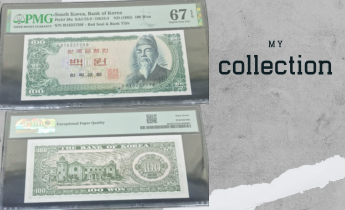


The 1983 Korean Banknote Reform and Its Cultural Significance
In the annals of Korean currency history, the year 1983 marks a significant milestone. This year saw the introduction of new 1,000-won and 5,000-won banknotes by the Bank of Korea, ushering in a standardized era of modern banknote aesthetics and security features.
This post respectfully presents an overview of the banknotes issued in that year, their design innovations, historical context, and continuing relevance to collectors and historians alike.
Introduction of the ₩1,000 Note Featuring Yi Hwang
Issued on June 11, 1983, the ₩1,000 banknote displays a central portrait of Confucian scholar Yi Hwang, also known as Toegye. This represented a departure from prior designs which positioned portraits to the side, thereby achieving greater visual symmetry and focus. The reverse of the note features a finely illustrated depiction of Dosan Seowon, a renowned Confucian academy associated with Yi Hwang. The note measures 141 mm by 68 mm and is printed in a refined blue-gray tone.
This banknote marked the beginning of Korea’s centrally-aligned portrait layout, establishing a new era in national currency design.

Introduction of the ₩5,000 Note Featuring Yulgok Yi I
Also released on June 11, 1983, the ₩5,000 banknote features Yulgok Yi I, a revered Confucian thinker and statesman, centered on the front side. The reverse showcases Ojukheon, his birthplace and one of Korea’s oldest wooden structures. The note's reddish-brown color and 146 mm × 73 mm dimensions were carefully chosen for visual harmony. This issuance also marked the beginning of Korea's enhanced anti-counterfeiting measures, including the adoption of watermark technology.
Its design reflects both the philosophical legacy of Yulgok and the growing importance of cultural heritage in monetary aesthetics.
Clarifying Common Misconceptions About 1983 Banknotes
It is important to clarify that certain misconceptions exist regarding banknotes allegedly issued in 1983. For instance, while Admiral Yi Sun-sin and King Sejong have appeared on Korean currency, neither appeared on any banknotes in that particular year. Furthermore, the ₩1,000 banknote featuring King Sejong was not introduced until 2007.
Accuracy in historical documentation is critical for collectors, archivists, and educators alike.
The Structural and Symbolic Impact of the 1983 Reform
The 1983 reform introduced several key features to Korea’s banknote system: first, a centrally-aligned portrait layout replaced previous asymmetric designs; second, standardization of banknote dimensions by denomination improved usability; third, the integration of prominent cultural landmarks alongside national figures elevated the symbolic richness of the notes; lastly, advanced printing techniques and security measures, such as watermarking and micro-patterns, enhanced anti-counterfeiting efforts.
This reform established a framework that has influenced subsequent generations of Korean banknote design.
Valuation Insights from a Collector’s Perspective
In pristine uncirculated condition, these 1983 banknotes command premium values among collectors. The ₩1,000 note typically ranges from ₩8,000 to ₩20,000, especially with serials like A000001 or consecutive numbers. The ₩5,000 note ranges from ₩15,000 to ₩40,000, with premiums for early serial numbers and PMG grades above 65.
Authentication and careful preservation are strongly advised to maintain long-term value.
Guidelines for Proper Preservation and Grading
To ensure long-term preservation, collectors are encouraged to use acid-free sleeves and store notes in UV-protected archival boxes. For official grading, reputable services such as PMG or Korea’s KOMSCO are recommended. Collectors should take extra care with notes featuring prefix-free or matching serial numbers, as these tend to appreciate in value.
Handling notes with gloves and avoiding unnecessary exposure to air or light will help retain optimal condition.
Conclusion – Cultural Legacy Encapsulated in Paper Currency
The 1983 issuance of the ₩1,000 and ₩5,000 banknotes represents far more than a routine currency update. It encapsulated a pivotal design shift, a commitment to national heritage, and the dawn of modern security standards in South Korean currency. These notes symbolize both historical continuity and innovation, offering insights into the nation’s cultural and philosophical priorities.
For collectors, these banknotes represent not only valuable items but also a profound connection to Korea’s evolving identity and heritage.